
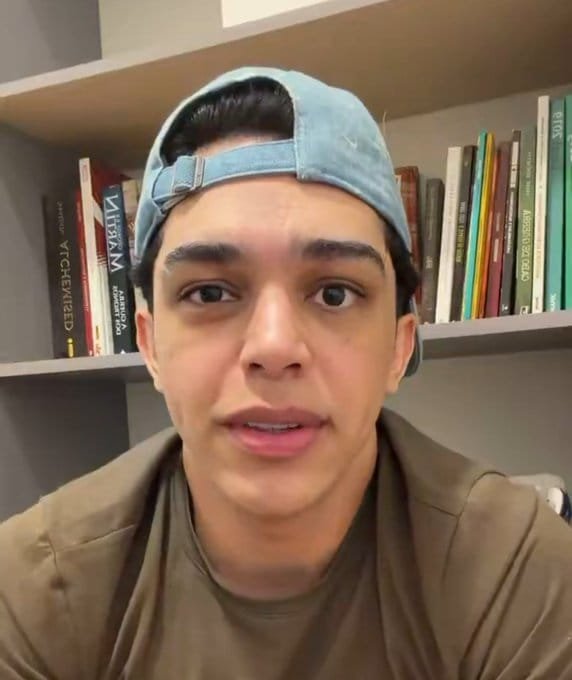
Brazilian digital content creator Davyn Silva has publicly denounced the unauthorized recording and subsequent online distribution of an intimate video of himself. The 22-year-old São Paulo native, known online simply as “davyn,” said the footage was captured without his knowledge or consent while he was intoxicated and later circulated on platforms including Telegram groups and the social network X.

In statements shared across his social media channels, Silva urged followers not to view or redistribute the material and confirmed he has begun legal proceedings against those involved.
The case has drawn attention both because of Silva’s existing online profile within adult LGBTQ+ content circles and because it highlights ongoing challenges around consent, privacy, and the rapid spread of intimate imagery in the digital age.
Silva, who maintains accounts on Instagram, TikTok, and X, has built an audience of approximately 158,000 followers on Instagram through content aimed primarily at adult members of the LGBTQ+ community. He has also gained wider recognition for earlier viral moments, including a humorous stunt during a World Cup period in which he appeared to play a horn using an unconventional body part.
Who Is Davyn Silva?
Davyn Silva is a young Brazilian content creator based in São Paulo. Public profiles and media reports describe him as a digital creator focused on adult-oriented material. He operates under the handle “davyn” or “davynsilva” across major platforms. At the time of the recent reports, his Instagram account listed roughly 158,000 followers. His work is directed toward an adult LGBTQ+ audience and includes both explicit and more personal or humorous content.
Earlier in his online career, Silva became known beyond niche circles for a light-hearted viral video linked to World Cup festivities. That clip, involving a horn and physical comedy, helped expand his visibility. On his platforms he has also shared personal reflections, including content tagged with themes related to autism and humor. Some online commentary has debated the nature of that material, with critics questioning certain approaches while supporters view it as part of his authentic personal expression. Silva himself has presented much of his output as creative and connected to his lived experience.
Like many independent adult content creators, Silva’s professional life involves producing and sharing intimate material under controlled conditions for paying or following audiences. In his own words regarding the leaked video, he distinguished between consensual professional work and the unauthorized recording: “I don’t mind having a video of myself, you know, without clothes, having sex, because that’s already my work. But it was a very intimate moment and without my consent.”
Details of the Incident According to Silva’s Account
According to statements Silva made in a video posted to social media around September 20, 2026, the events unfolded after he met a man named Mateus who already followed his online work. The two arranged to meet at Silva’s home and engaged in intimate activity. Silva said he even produced a vlog documenting aspects of the encounter and consumed wine both before and after filming professional-style content.
Later, while he was intoxicated, the other man allegedly recorded additional intimate footage without Silva’s knowledge or permission. Silva later discovered that the material had been shared online, appearing in Telegram groups and on accounts on X. He described feeling shaken by the discovery and stated that he has initiated judicial measures against the individual he holds responsible for the recording and against any parties or groups continuing to distribute the images.
Silva specifically asked followers not to search for, view, or share the video. He requested that people instead send him links so he could pursue formal complaints and legal action. “Just send them to me so I can report them. I am suing everyone who is posting this, every Telegram group that is posting,” he said in one reported statement. He emphasized that the core issue was the lack of consent for that particular recording and its subsequent spread.
Media outlets including Portal POP Mais and Portal Viggo covered the story shortly after Silva’s posts. The POP Mais report, published around September 22, 2026, provided basic biographical context and reiterated Silva’s call not to share the material. Portal Viggo offered a more detailed summary of Silva’s video statement, including the name Mateus and the sequence of events involving alcohol and the unauthorized recording.
Legal Framework in Brazil
In Brazil, the non-consensual distribution of intimate images is addressed under Article 218-C of the Penal Code. This provision, introduced and later updated through legislation including Law 13.718/2018 and subsequent amendments, criminalizes offering, exchanging, making available, transmitting, selling, distributing, publishing, or disseminating photographs, videos, or other audiovisual records that contain scenes of sex, nudity, or pornography without the victim’s consent. The same article also covers related conduct involving scenes of rape or the sexual exploitation of vulnerable persons.
Penalties have varied with legislative updates. Earlier versions prescribed reclusion of one to five years if the act did not constitute a more serious crime. Later amendments reportedly increased the range in certain formulations. Aggravating circumstances can raise the penalty by one-third to two-thirds when the perpetrator has or had an intimate relationship with the victim or when the motive involves revenge or humiliation. The law treats the dissemination itself as the core offense; consent for the original recording does not automatically authorize later public distribution.
Victims are generally advised to file a police report, preferably with specialized cybercrime units or women’s police stations where applicable, preserve evidence such as links, screenshots, and timestamps, and notify platforms to request removal. Civil actions for damages and injunctions seeking content takedowns are also common. Silva has indicated he is pursuing such measures both against the alleged recorder and against redistributors.
Legal experts note that intoxication can complicate questions of capacity to consent to recording, and that surreptitious filming during private encounters frequently forms the basis of complaints under the statute. The rapid circulation of material via messaging apps such as Telegram and public platforms such as X often multiplies the harm and the number of potential defendants.
Public Reaction and Online Discussion
Reaction on social media has been mixed. Supportive comments have focused on the principle of consent and the right of adult content creators to control the boundaries of their professional and private lives. Many users echoed Silva’s request not to share the video, pointing out that further distribution compounds the violation.
Other commentary has been skeptical or critical. Some users suggested the leak might have been orchestrated or exaggerated for engagement, a claim for which no independent evidence has been publicly verified. Separate criticism has targeted aspects of Silva’s broader content, particularly material that incorporates autism-related themes or humor. A number of posts argued that certain creative choices crossed lines regarding the sexualization of neurodivergence. These critiques exist alongside defenses of Silva’s right to express his identity and experiences. The discussion illustrates how personal branding, adult work, and sensitive identity topics frequently collide in online spaces.
News coverage itself has remained relatively restrained, focusing on Silva’s statements and the basic facts of the reported non-consensual recording rather than amplifying the leaked material. Outlets have generally avoided embedding or linking to the unauthorized video.
Broader Context: Intimate Image Abuse and Digital Privacy
Cases involving the non-consensual distribution of intimate images—sometimes called “revenge porn” even when revenge is not the motive—have become a recurring feature of digital life. In Brazil, high-profile examples have involved entertainers, athletes, and ordinary citizens. The 2025 incidents involving singer MC Mirella and her partner Dynho Alves, in which adult content originally produced for paid platforms later circulated widely on Telegram and X, generated extensive public debate about platform responsibility, piracy of paid content, and the difficulty of fully removing material once it spreads.
Similar dynamics appear in other countries and across different demographics. Adult content creators occupy a particularly complex position: they routinely produce and monetize intimate material under explicit agreements, yet remain vulnerable when recordings made outside those agreements, or copies of paid content, escape controlled distribution channels. The distinction Silva drew—between professional work he chooses to share and a private moment recorded without permission—is one many creators emphasize.
Technological factors accelerate the problem. Messaging applications with large group features, ephemeral stories that are nevertheless easily screenshot, and algorithmic amplification on public platforms all contribute to rapid dissemination. Once material leaves the original device, complete erasure is often impossible. Platforms respond with varying degrees of speed to removal requests, and legal processes can take months or years.
Psychological and social impacts on victims are well documented in academic and advocacy literature. Victims frequently report anxiety, depression, damage to relationships and professional opportunities, and a lasting sense of loss of control. For LGBTQ+ individuals and sex workers or adult creators, additional layers of stigma can intensify the harm. Public campaigns and legal reforms in multiple jurisdictions have sought to improve remedies, including streamlined takedown procedures, criminal penalties, and civil causes of action.
Prevention advice commonly offered by digital safety organizations includes limiting the creation of intimate recordings when trust is incomplete, using secure devices and encrypted storage, discussing boundaries explicitly before any recording, and being cautious about alcohol or substance use in situations involving new acquaintances. When a leak occurs, rapid documentation of evidence, platform notifications, and legal consultation are the standard recommended steps.
The Role of Platforms and Enforcement Challenges
Telegram groups and X accounts have featured prominently in recent Brazilian cases of intimate image distribution. Telegram’s design, which supports large anonymous groups and limited content moderation in some channels, has made it a frequent vector. X has faced criticism for the speed with which sensitive material can spread before automated or human moderation intervenes.
Brazilian authorities and courts have increasingly ordered platforms to remove specific content and, in some instances, to provide user data for identification of posters. Enforcement remains uneven, particularly when accounts are created solely for distribution, use virtual private networks, or operate from outside Brazil. Silva’s stated strategy of collecting links and pursuing both the original recorder and redistributors reflects the multi-front approach often required.
Legislative attention continues. Updates to Article 218-C and related provisions aim to keep pace with technology, though critics argue that penalties alone cannot fully address the scale of online distribution. Education about consent and digital literacy is frequently cited as a complementary necessity.
What Happens Next
As of the most recent public reports in late September 2026, Silva has not released further detailed updates on the status of his legal actions. He continues to ask the public to refrain from searching for or circulating the video. Media coverage has largely respected that request by focusing on the allegations of non-consent rather than the content itself.
The case serves as a reminder that consent is specific to context and time. Permission to engage in intimate activity or to create professional adult content does not automatically extend to unauthorized recording or public distribution. For creators whose livelihoods involve controlled exposure, the boundary between professional and private remains critical and, as this incident illustrates, fragile.
Observers will watch whether the legal process yields identifiable results against the individual named Mateus and against secondary distributors. More broadly, the episode adds to the growing body of examples demonstrating that intimate image abuse affects people across occupations, identities, and levels of online fame. Effective responses require a combination of individual caution, platform accountability, accessible legal remedies, and cultural recognition that non-consensual distribution is a serious violation rather than entertainment or gossip.
Davyn Silva’s public stance—acknowledging his professional comfort with certain forms of exposure while drawing a firm line at non-consensual recording—underscores a principle that applies far beyond any single creator: control over one’s own image and intimate moments is a fundamental aspect of personal autonomy in both offline and digital life. As the investigation and any resulting proceedings move forward, that principle remains at the center of the story.
This article is based on public statements by Davyn Silva and contemporaneous reporting from Brazilian outlets including Portal POP Mais and Portal Viggo. It does not reproduce or link to any unauthorized material. Readers are encouraged not to seek or share non-consensual intimate imagery.